An informal term, Ozempic face, is used to describe the facial changes that can occur when a person loses weight, particularly quickly, as a result of GLP-1 receptor agonist medications. These medications include Ozempic (semaglutide), Wegovy, or Mounjaro (tirzepatide). It is not a medical diagnosis, but rather a widely recognized pattern of facial volume loss and laxity that can make the face appear gaunt, hollow, or older than it is.
When the body loses fat through any means, the face is often one of the areas where changes become most visible. The subcutaneous fat compartments of the face, which give it a healthy, rounded, youthful contour, shrink as overall body fat decreases. The faster this happens, the more pronounced and noticeable the change tends to be.
Common signs of Ozempic face include:
Over 40 million people in the United States have taken GLP-1 medications. The results have been impressive, with millions of patients enjoying better health through significant weight loss. But as with any major physiological shift, there are side effects, and one of the most visible is what has come to be known as Ozempic face.
This is a relatively new medical issue, and not everything about it is yet fully understood. What is clear is that the weight loss these medications produce creates meaningful changes in facial appearance that many patients find distressing — particularly those who feel their face no longer reflects how healthy and confident they feel in their body.
Dr. Fred Fedok, Adjunct Professor of Surgery at the University of South Alabama, has made the comprehensive management of post-GLP-1 facial aging a clinical focus. His approach integrates a deep understanding of the biological mechanisms behind these changes with a full spectrum of surgical and non-surgical solutions fit to each patient’s unique anatomy and goals.
BOOK YOUR CONSULTATION
Understanding Ozempic face causes requires looking at both the biological mechanisms of GLP-1 medications and the anatomy of facial aging. GLP-1 receptor agonists work by mimicking a gut hormone that regulates appetite and slows gastric emptying, producing a sustained caloric deficit that leads to significant, often rapid weight loss. That weight loss is systemic: the body draws from fat stores, including the subcutaneous fat compartments of the face.
The face is supported by a layered system of bone, muscle, fibrous tissue, discrete fat compartments, and skin. These fat compartments are what give the face its youthful fullness and smooth contour. When they shrink, the overlying skin, which has its own reduced elasticity due to the weight loss, cannot contract proportionately. The result is the hallmark appearance of Ozempic face: a gaunt, hollowed, or prematurely aged face and neck.
Several factors can increase the likelihood or severity of Ozempic face:
It is important to note that Ozempic face is not caused by the medication, but is a consequence of fat loss occurring throughout the body.
Browse Dr. Fedok’s real patient gallery to see natural, balanced improvements in facial volume and definition achieved through his personalized surgical and non-surgical approach.
VIEW THE GALLERY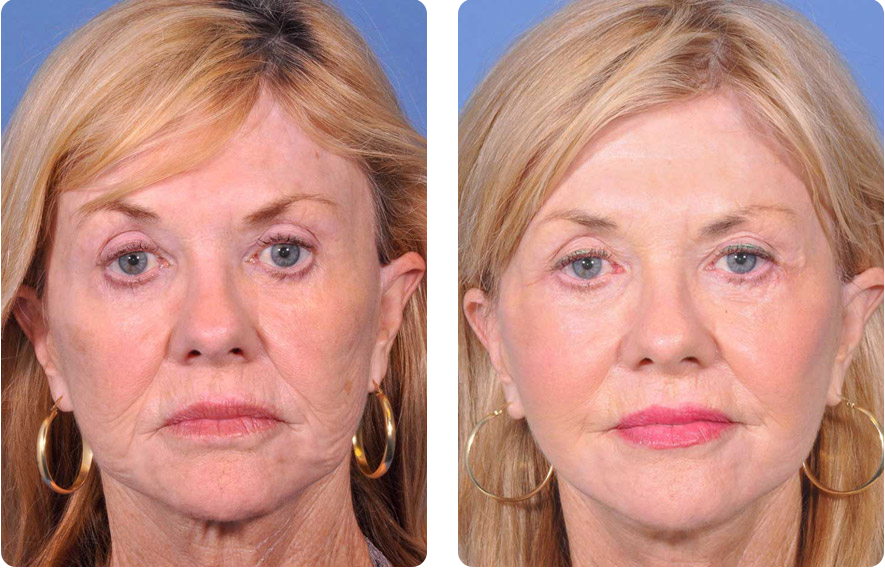
Dr. Fedok is at the forefront of defining best practices for a relatively new medical issue. His accepted presentation at the 2027 Multispecialty Aesthetic Conference, ‘The Comprehensive Approach to Facial Rejuvenation for the Patient After GLP-1 Use: Ozempic Face,’ represents an extensive review of the biological mechanisms behind post-GLP-1 facial aging and concludes with his evidence-based recommendations for managing it.
This level of clinical engagement is rare, and it directly informs every consultation at his Foley practice.
Dr. Fedok is the Past-President of the American Academy of Facial Plastic and Reconstructive Surgery (AAFPRS) and is widely published and lectures extensively nationally and internationally on facial cosmetic and reconstructive surgery. His innovative practice focuses on the individual needs of each patient to ensure top-quality outcomes. Patients across Foley, Gulf Shores, Daphne, Fairhope, and throughout the Gulf Coast region trust Dr. Fedok for results that are natural, balanced, and grounded in the same evidence-based approach he presents to his peers at national conferences.
Contact Us
Dr. Fedok evaluates each patient individually, reviewing the extent of volume loss, skin quality, degree of laxity, and overall facial structure before recommending a treatment plan. No two Ozempic face presentations are identical, and no single treatment is right for everyone.
For patients with mild to moderate facial volume loss or early skin laxity, non-surgical options can restore a natural, refreshed appearance without surgery or extended recovery. Dr. Fedok offers the following non-surgical treatments for Ozempic face at his Foley office:
Hyaluronic acid fillers can restore volume to the cheeks, temples, nasolabial folds, and under-eye area. Unlike traditional cheek augmentation, the goal with Ozempic face is to restore what was lost, not to add volume beyond a natural baseline.
Microneedling with radiofrequency (RF) energy, including Morpheus8, stimulates collagen and elastin production in the dermis, improving skin texture, tone, and mild laxity without requiring injections or surgery. Microneedling for Ozempic face is particularly effective when skin quality is compromised.
Strategic placement of neuromodulators can subtly lift and refine certain areas of the face, reducing the pull of muscles that contribute to jowling and marionette lines.
The treatment protocol uses bipolar radiofrequency energy delivered beneath the skin to improve laxity and contraction along the jawline and lower face, providing a skin-tightening effect in areas where volume loss has led to redundant skin.
Using the same RF technology as FaceTite, AccuTite is calibrated for smaller, more precise areas, particularly around the eyes, nasolabial folds, and perioral region, where Ozempic face changes can be subtle but impactful.
When volume loss and skin laxity coexist, non-surgical treatments alone are often insufficient. Dr. Fedok’s surgical options provide the most comprehensive and durable correction for moderate to severe concerns.
For patients with significant jowling, deep nasolabial folds, neck laxity, and volume loss, a facelift combined with fat transfer addresses both the structural descent and the volume deficit in a single procedure. Fat grafting uses the patient’s own fat to restore the subcutaneous compartments of the face, while the facelift repositions and tightens the underlying tissue and removes redundant skin. This lift-and-fill approach is widely considered the most effective treatment for advanced Ozempic face presentations. Autogenous fat and nanofat – from the patient themselves is believed to be among the most potent and effective means of supplying effective growth factors into a patient’s tissues. It thus has particular attractiveness in this situation where much of the patient’s biologic reserves are depleted with significant weight loss.
Rapid weight loss accelerates laxity in both the face and neck simultaneously. Dr. Fedok addresses both in a single procedure, repositioning facial tissue and tightening the neck, including platysmal banding and loose submental skin, for a comprehensive result.
For patients whose primary concern is volume loss without significant skin laxity, fat grafting alone can restore a natural, full, youthful facial appearance. Fat is harvested from a donor site (commonly the abdomen or thighs), processed, and meticulously injected into depleted facial compartments. Results are natural and long-lasting. The replenishing of healthy volume with fat restores youthful contours.
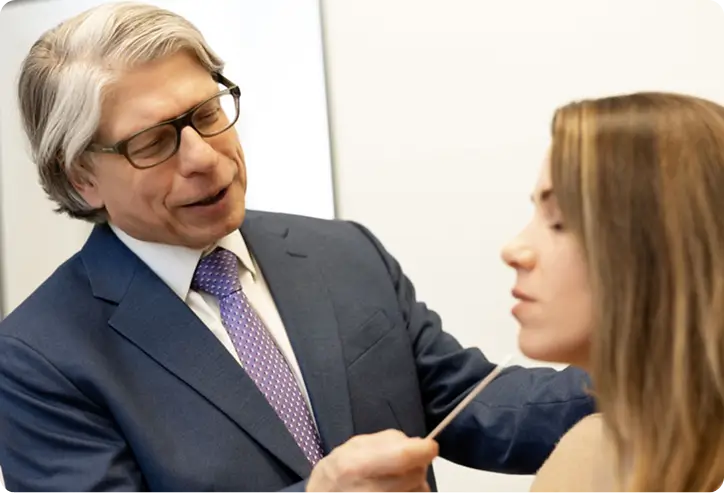
Addressing the facial changes associated with Ozempic face can meaningfully restore confidence and appearance:
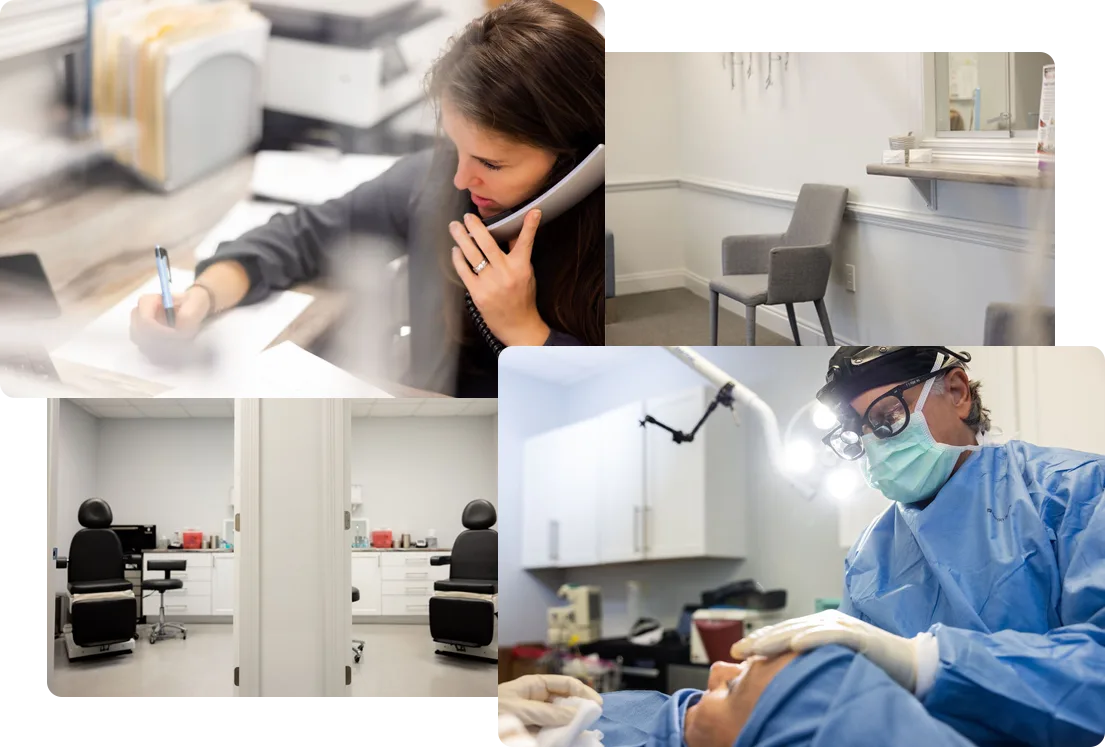
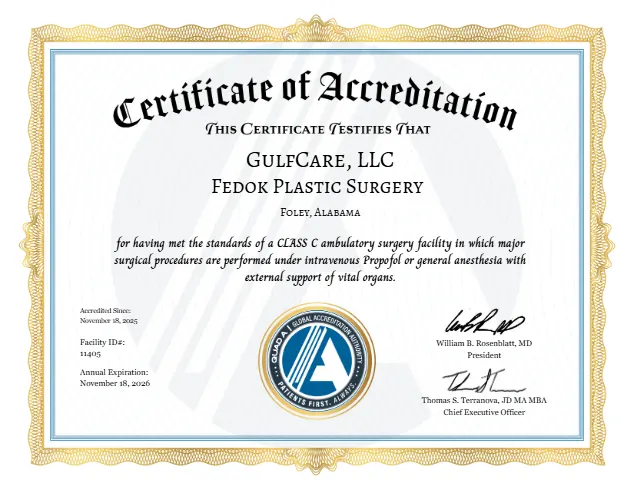
All procedures are performed in our Quad A–Accredited surgical facility, which has been independently evaluated for anesthesia safety, sterile processing, emergency readiness, and strict surgical standards. Patients can feel confident knowing their care meets national hospital-level protocols in a private, specialized environment.
If you are noticing hollowing, loose skin, or a drawn appearance after using Ozempic or another GLP-1 medication, Dr. Fedok can evaluate your facial profile and present the full range of options.
Book a private consultation at Fedok Plastic Surgery in Foley, AL, and find out exactly what your face needs.
BOOK YOUR CONSULTATION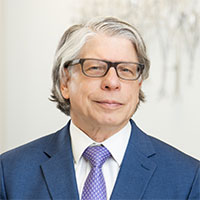
By Dr. Fedok, a well-respected and widely published double board-certified plastic surgeon whose before and after gallery, RealSelf and Google Reviews reflect his trusted expertise.
For some patients, partial volume returns if weight is regained after stopping medication, but this is unpredictable and unreliable. For most, volume loss and skin laxity are not self-correcting and require targeted treatment.
The best filler depends on the degree and pattern of volume loss. Hyaluronic acid fillers (such as Juvederm Voluma or Restylane Lyft) work well for targeted, localized areas like the lips and other limited areas and provide immediate results. Dr. Fedok will assess your anatomy and recommend the approach best suited to your presentation.
Lose weight gradually, maintain adequate protein intake, use medical-grade skincare with retinoids, and apply sunscreen daily. Early consultation with Dr. Fedok is advisable; proactive collagen-stimulating treatment before significant volume loss occurs is more effective than correcting established changes. Keep in mind the development of undesirable changes and their correction highly depend on patient factors, that is, age and overall health.
Microneedling, particularly RF microneedling with Morpheus8, can improve skin quality, texture, and mild laxity associated with Ozempic face by stimulating collagen and elastin in the dermis.
Our Foley office is conveniently located for patients across the Gulf Coast and beyond — we serve communities throughout Alabama, Florida, Georgia, Louisiana, Mississippi and Texas.